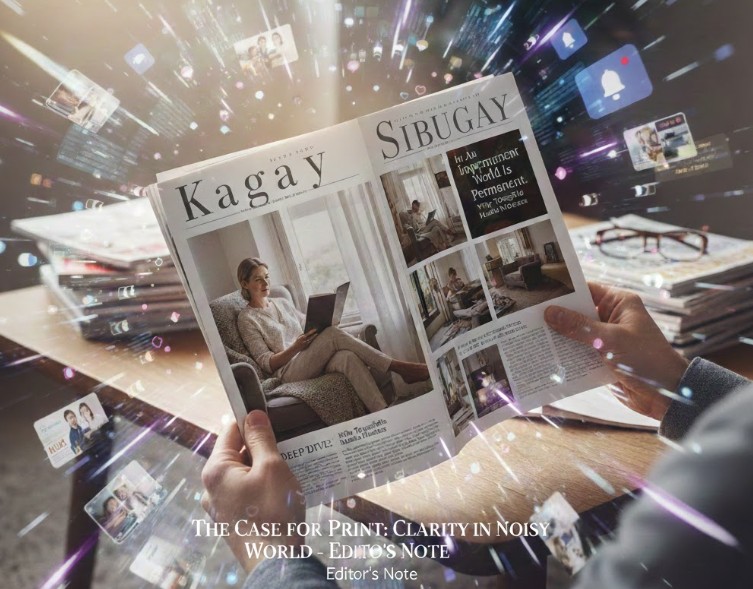
The Case for Print: Clarity in a Noisy World
Editor's NoteIn a world where information flashes by at the speed of a scrolling thumb, it’s tempting to view traditional print media as relics of a bygone era. Yet to dismiss print as outdated is to misunderstand what it uniquely offers in an age oversaturated with digital noise. Print is not merely surviving; it continues to serve an irreplaceable role in how we think, feel, learn, and connect.
1. Print Slows Us Down - In the Best Possible Way The digital world thrives on immediacy. Notifications chime. Ads pop. Videos autoplay. Even as we read, something else competes for our attention. Print, on the other hand, invites us to slow down. The physical act of holding a magazine, turning its pages, and immersing oneself in carefully curated layouts creates an experience impossible to replicate on a screen. Reading print is intentional. It’s focus without the temptation of a dozen other open tabs.
2. Print Offers Trust, Credibility, and Craft In an era marked by misinformation, the enduring credibility of print publications is more valuable than ever. Print demands an editorial rigor that the digital space, with its pressure for speed and volume, often sacrifices. Every article must earn its place on a physical page. Writers, editors, fact-checkers, and designers collaborate to produce work meant to be read - not merely clicked. This craftsmanship fosters trust. When readers open a magazine, they are entering a space built on purpose, not algorithmic manipulation.
3. Print Creates a Tangible Relationship With Readers There is a reason people still save magazines, clip articles, and stack their favorite issues on coffee tables. Print becomes part of our physical environment. It sparks conversations in a way a link rarely does. A magazine can be shared, gifted, or rediscovered years later, its message preserved exactly as it was first presented. Digital content is endless and ephemeral; print is finite, curated, and memorable.
4. Print Is Where Design and Storytelling Thrive Magazines are visual experiences. The interplay of photography, typography, layout, and texture elevates storytelling beyond simple words. A well-designed spread can move a reader before they’ve read a single sentence. Digital media compresses, crops, resizes, and rearranges. Print presents stories exactly as their creators intended that is, with full-bleed images, elegant fonts, and margins that breathe. It is artistry as well as journalism.
5. Print Offers a Sanctuary From Digital Overload As more people seek time away from screens for both mental clarity and health, print provides the perfect refuge. Reading a physical magazine does not drain your battery or track your behavior. It doesn’t demand your data, your clicks, or your privacy. It simply offers information and inspiration - nothing more, nothing less.
6. Print and Digital Are Not Enemies - They Are Complements The conversation should never be “print versus digital,” but “print and digital.” While digital media excels at immediacy and reach, print excels at depth and immersion. Together, they create a fuller and more balanced information ecosystem. Magazines that embrace both formats offer their audiences the best of both worlds via thoughtful print editions and dynamic digital content.
7. In an Impermanent World, Print Is Permanent When everything lives in a feed that updates every second, permanence becomes precious. Print gives stories a lasting home. It allows ideas to endure beyond the ever-shifting tides of trending topics. A magazine issue is a time capsule; an artifact of culture, thought, and conversation.
The Final Word: Print Is Not Going Away - Nor Should It
Print media matters today because it offers what digital cannot: depth over distraction, craftsmanship over chaos, and connection over consumption. It remains a testament to the power of storytelling done with intention.
In the rush toward the next technological breakthrough, we should not forget the profound impact of holding a beautifully crafted magazine in our hands. Print media is not just relevant - it is essential. And as long as people continue to seek meaningful, mindful, and trustworthy experiences, print will continue to thrive.
