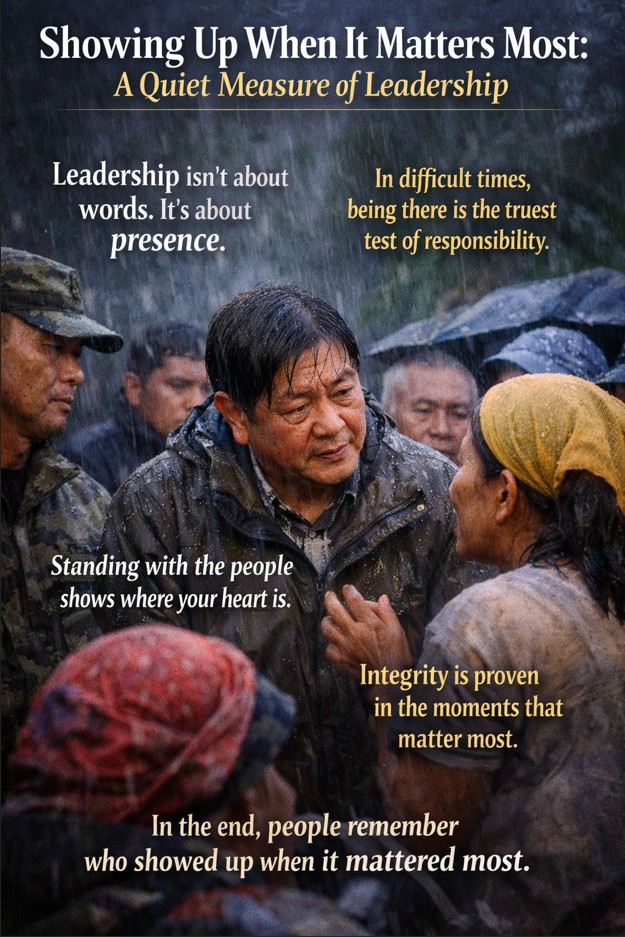
Showing Up When It Matters Most:
A Quiet Measure of Leadership In calm seasons, leadership can look polished, well-worded statements, scheduled appearances, and carefully framed promises. But in difficult times, when uncertainty rises and public trust wavers, a different measure emerges. It is no longer about optics. It is about presence.
Showing up, especially during trying times, is one of the simplest yet most powerful acts of leadership. It does not always require grand speeches or dramatic solutions. Sometimes, it is as basic as facing questions, listening to concerns, and standing visibly with the people you serve. In those moments, presence becomes proof- proof that responsibility is not conditional, and that accountability is not selective.
In the Philippines, where politics often unfolds under intense public scrutiny, the act of showing up carries deeper meaning. Citizens do not merely watch what leaders say, they observe when leaders choose to be seen and when they choose not to be. Absence, in moments that demand clarity, can create space for doubt. Presence, even without perfect answers, can build trust.
Integrity is often spoken of as a moral principle, but in practice, it reveals itself through consistency. It is reflected in whether a leader stands firm when it is inconvenient, whether they remain accessible when criticism intensifies, and whether they choose transparency over silence.
ADVERTISEMENT
Truth, in the same way, is not only about facts, it is about the willingness to face those facts publicly, even when they are uncomfortable.
Recent national conversations have underscored how important these values are. As political figures navigate complex and sometimes contentious issues, the public is not only evaluating policies or decisions, well, at least the thinking public. They are observing character. They are asking quiet but important questions: Who shows up when it counts? Who speaks when silence would be easier? Who remains steady when pressure mounts?
These questions do not always demand direct answers. Instead, they are answered over time, through patterns of action or inaction. In this sense, leadership becomes less about declarations and more about demonstration.
For many Filipinos, especially in communities far from the centers of power, showing up is a deeply personal expectation. It reflects a cultural value rooted in shared humanity. To show up is to acknowledge that leadership is not distant; it is relational. It says, “I am here with you,” even when solutions are still unfolding.
This is why presence matters most in moments of strain. When institutions are tested and narratives compete, what anchors public confidence is not perfection, but sincerity. Not grandstanding, but groundedness. Not avoidance, but engagement.
In the end, the strength of leadership is not only measured by what is achieved, but by how it is carried out especially under pressure. Showing up may seem like a small act, but in times that demand courage, it becomes a defining one.
Because when the noise fades and the headlines pass, what remains is this: people remember who stood their ground, who faced the moment, and who chose to be present when it mattered most.